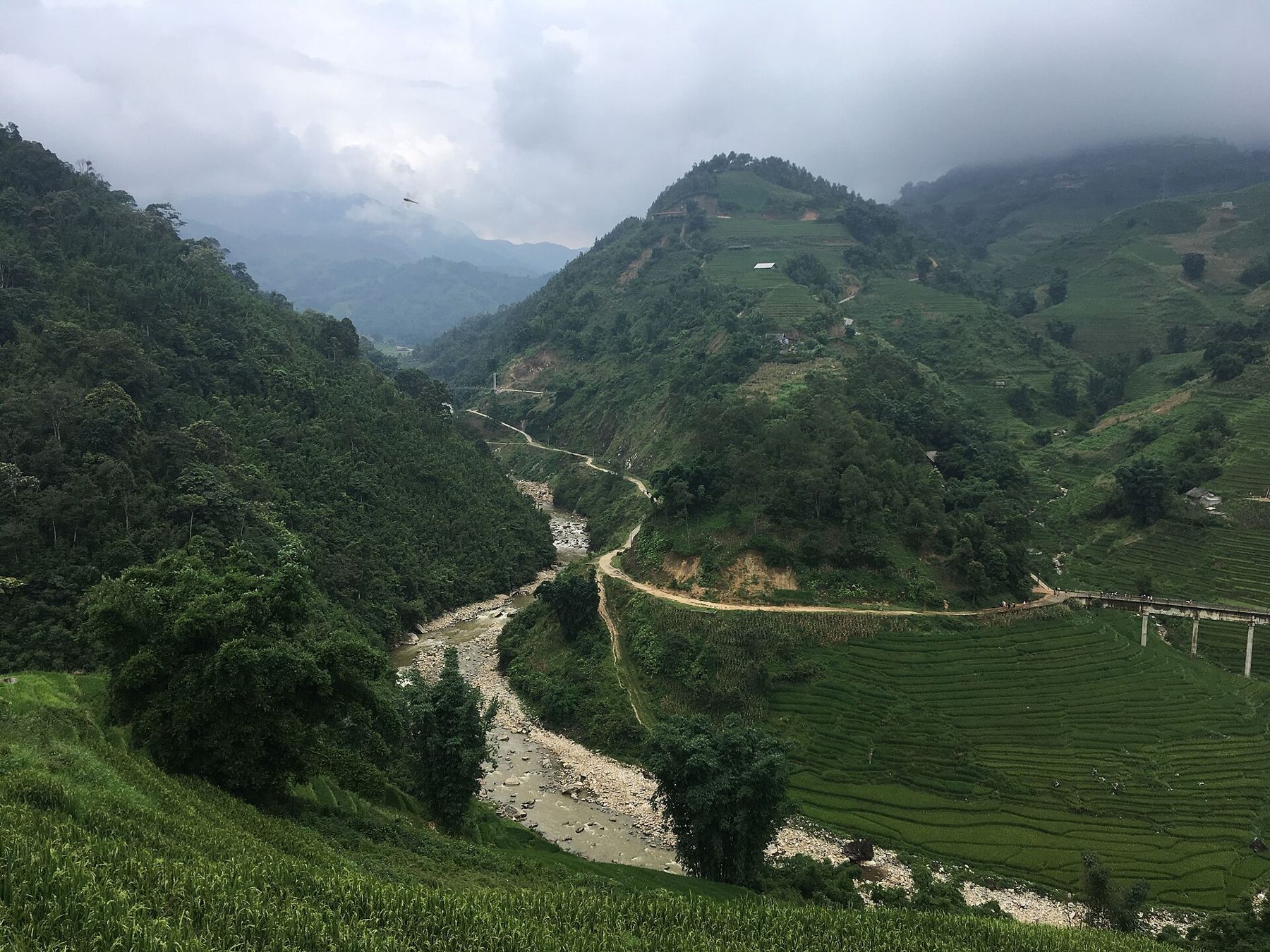
Sa Pa (Sapa) sits on a ridge in the Hoàng Liên Sơn mountains, a little over 1,500 metres above sea level, in a landscape shaped by generations of farmers. The French built a hill station here in the early twentieth century, and the stone church in the town centre is a reminder of that period. But the reason to come is outside town: the long valleys below, where rice terraces step down the slopes in curves that follow every fold of the hill, and the villages of Hmong, Dao, Giáy and other communities who have farmed them for generations.
The Mường Hoa valley
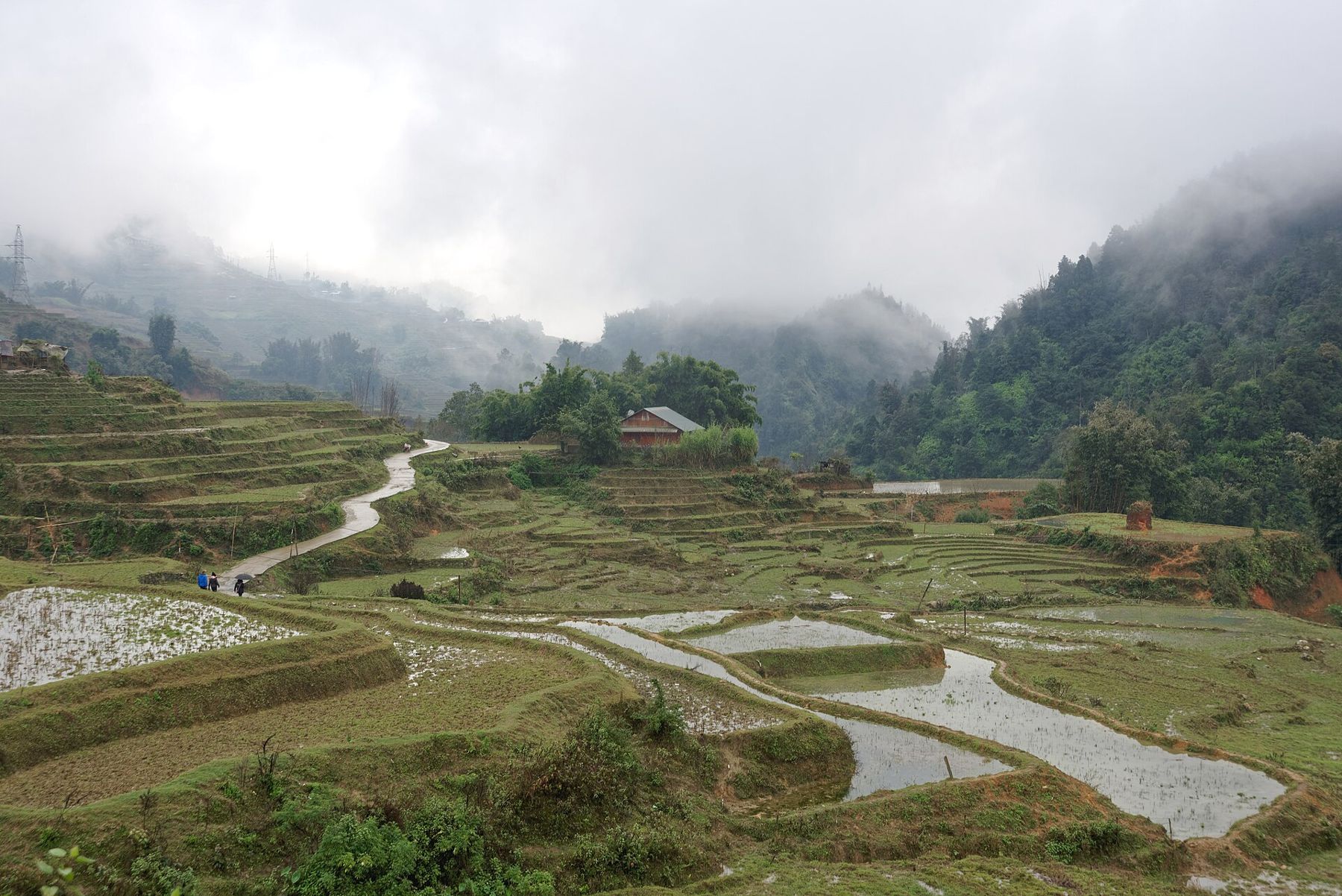
The Mường Hoa valley runs south-east from Sa Pa town, with a river along its floor and terraces climbing both sides. It is the most walked valley in the region, and for good reason: the trails link a string of villages, so you can walk for a morning or for several days and sleep in a family homestay along the way.
The classic route drops from the edge of town to Lao Chải, a Hmong village, then follows the valley to Tả Van, where Giáy and Hmong families live side by side. Beyond lie Hầu Thào, Giàng Tả Chải and, further still, Bản Hồ. On the valley floor near Hầu Thào is a field of large boulders carved with ancient lines and patterns, a protected site whose origins are still debated.
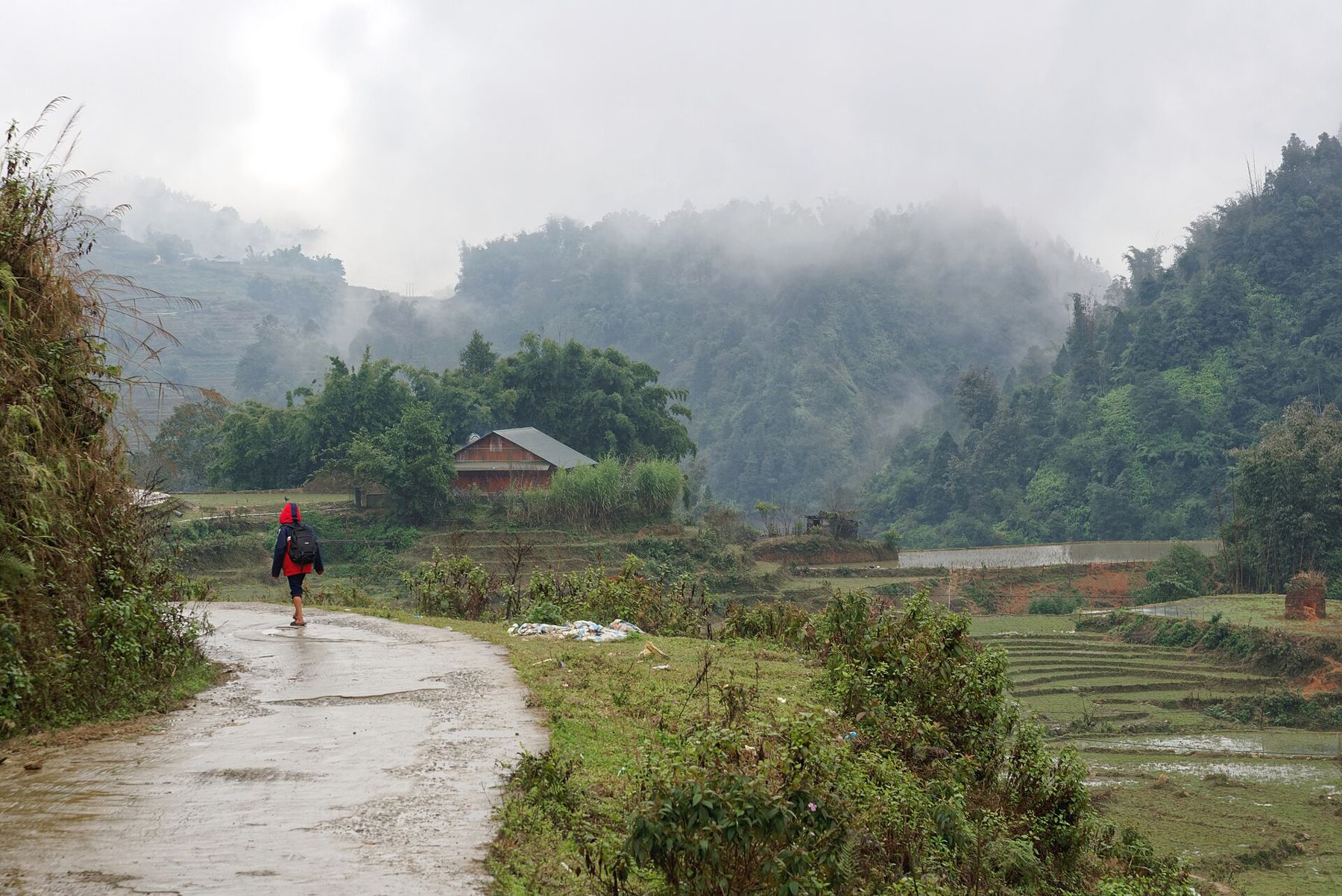
Paths range from wide concrete tracks to narrow mud trails along the terrace walls. After rain the clay turns slick, and you will understand at once why village women walk them in rubber boots.
©
CAMERA: Jakub Hałun // CC BY 4.0How the terraces change
The terraces look different almost every month, and choosing when to come is choosing which version you see.
- Spring, around April and May: the paddies are flooded before planting, and on a clear evening they reflect the sky like stacked mirrors.
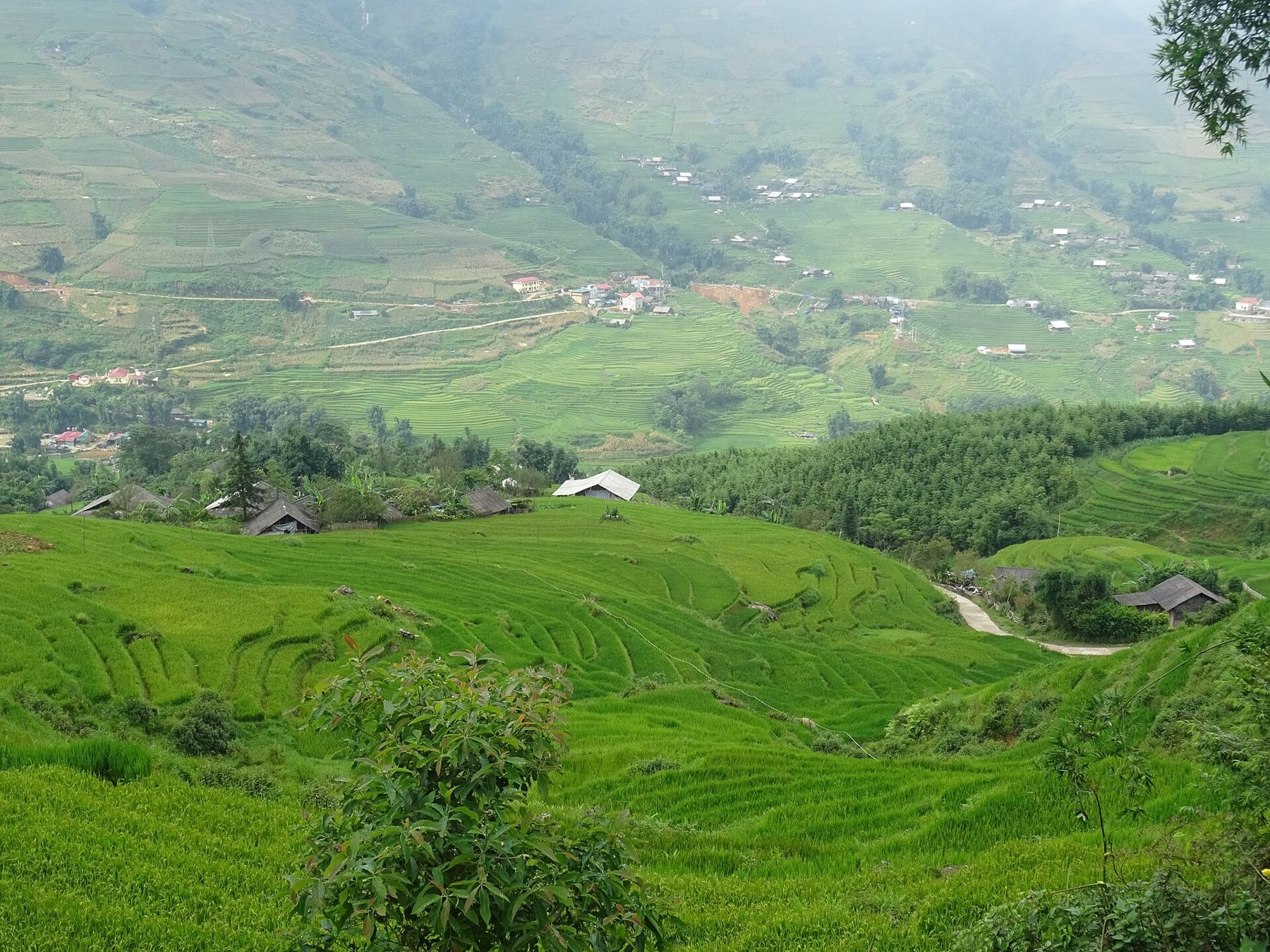
- Early summer: young rice goes in and the slopes turn bright green.
- July and August: deep green, with heavy rain and the highest chance of landslides on mountain roads.
- Late August to early October: the rice ripens to gold and the harvest begins. This is the most popular time, and the trails are busiest.
- Winter: the fields lie bare and brown, mist settles in the valleys, and nights can be close to freezing; frost and even snow occasionally reach the high ground.
Planting and harvest dates shift with altitude and the year's weather, so a valley a few hundred metres lower can be weeks ahead of one higher up. If gold is what you want, aim for mid to late September and stay flexible.
©
CAMERA: Christophe95 // CC BY-SA 4.0Beyond the main valley
If the Mường Hoa trail feels crowded, other directions are quieter. Tả Phìn, north of town, is a Red Dao village known for its herbal baths, made from plants gathered on the surrounding hills, and for fine embroidery. West of town the road climbs to the Ô Quy Hồ pass, one of the longest and highest mountain passes in the north, with long views over the Hoàng Liên Sơn range when the cloud lifts. Ask a guide about less walked trails between villages; routes change as new roads are cut and old paths fall out of use.
Walking with local guides
You can walk the main valley trail without a guide, but you will understand far more with one. Many guides in Sa Pa are women from the surrounding villages who learned English, and often other languages, from years of walking with visitors. A good guide can explain how terraces are built and watered, what is being grown in each season, how indigo cloth is dyed and why a particular house faces the way it does.
A good guide can explain how terraces are built and watered, what is being grown in each season, how indigo cloth is dyed and why a particular house faces the way it does.
When you hire a guide, it is worth asking directly whether they come from the villages you will pass through. Money that stays in those communities makes a real difference. Agree on the route, the length of the day and what is included before you set off.
 Coming up after thisHanoi's Old Quarter after dark
Trekking respectfully
The villages are homes, not open-air museums, and the fields you admire are someone's harvest. A few habits go a long way.
- Stay on the paths and the tops of the terrace walls. Stepping into a paddy can damage the crop and the wall.
- Ask before you photograph people, and before you enter a house or courtyard.
- Do not hand out sweets, money or gifts to children. If you want to help, buy directly from the makers or support the village school through your guide or homestay.
- Dress modestly in villages, especially away from the main trail.
- Expect to be offered handicrafts. A polite, smiling no is fine; so is buying something you actually want.
- Carry your rubbish back to town.
Fansipan, on foot or by cable car
Fansipan, at a little over 3,100 metres, is the highest mountain in Vietnam and in the wider Indochinese peninsula. It rises inside Hoàng Liên National Park, west of town. A cable car now carries visitors most of the way to the summit, followed by steps or a short funicular to the top, and on a clear day the views across the range are remarkable. On a cloudy one, which is common, you may see nothing but white.
Climbing on foot is a serious mountain walk. Most people take one or two days on the established trails, with a guide, a park entry ticket and, for the longer version, a night at a mountain camp. The trails are steep and muddy, and the weather on the summit can turn cold and wet fast. Rules for climbers in the park change from time to time, so check the current requirements in Sa Pa before you go.
©
CAMERA: Jakub Hałun // CC BY 4.0Getting there and staying over
Sa Pa is reached through Lào Cai, the city on the Chinese border. You can take an overnight sleeper train from Hanoi to Lào Cai station and then a road transfer of about an hour up the mountain, or a direct bus on the expressway, which takes most of a day. Our guide to choosing a berth on a night train covers what to expect on board.
Two nights is the minimum to walk the valley without rushing; three gives you time for a longer trek or a day held back for bad weather. Bring shoes with real grip, a rain jacket in every season and a warm layer for the evenings. Sa Pa pairs well with the far north: riders often continue to the Hà Giang loop or head back to Hanoi for a few days of noodle soups and street food before going south.